Τρίτη 4 Ιουνίου 2019

Δευτέρα 3 Ιουνίου 2019

Thor


Thor was the god of thunder and of the sky in Norse* and early Germanic mythology. Though Odin* held a higher rank, Thor seems to have been the best loved and most worshiped of the Norse deities. He belonged to the common people, while Odin appealed to the learned and noble classes. A patron of farmers, Thor was associated with weather and crops. Although he could be fearsome, many myths portray him in a comic and affectionate way.

Origins and Qualities. Thor appears throughout Norse mythology as a huge, strongly built, red-bearded fellow with a huge appetite. He grew out of Donar or Thunor, an ancient god of sky and thunder. Some myths say that Thor was the son of Odin and Fjorgyn, the earth goddess. His wife was the beautiful goddess Sif, who seldom appears in myths and remains a somewhat mysterious figure.
Generally good-natured, Thor had a hot temper, and his anger was dreadful to behold. He was a fierce enemy of the frost giants, the foes of the Norse gods. When people heard thunder and saw lightning in the sky, they knew that Thor was fighting these evil giants.
The thunder god's chief weapon was his mighty hammer Mjollnir, or Crusher, which the dwarfs had forged for him. When he threw Mjollnir, it returned magically to his hand like a boomerang. Among Mjollnir's other powers was the gift of restoring life to the dead. The connection of Thor's hammer with life and fertility gave rise to the old Norse customs of placing a hammer in a bride's lap at her wedding and of raising it over a newborn child.
deity god or goddess
patron special guardian, protector, or supporter
Thor's treasures also included a magical belt that doubled his strength whenever he wore it and a pair of goats, Tanngniost and Tanngrisni (both "Toothgnashers"), that pulled his chariot across the sky. Whenever he was overcome with hunger, Thor would devour his goats, only to return them to life with Mjollnir.
Thor, the Norse god of thunder and the sky, appears in the center of this tapestry holding his mighty hammer.
Myths About Thor. According to one well-known myth about Thor, Thrym, king of the giants, came into possession of Mjollnir and declared that he would give it back to Thor only if the beautiful goddess Freyja agreed to marry him. She angrily refused, and the trickster god Loki came up with a clever plan to recover Mjollnir. Using women's clothing and a bridal veil to disguise Thor as Freyja, Loki escorted "Freyja" to Jotunheim, the home of the giants. Thrym greeted his bride, though he was surprised at her appetite at the wedding feast. "Freyja" consumed an entire ox, three barrels of wine, and much more. Loki explained that she had been unable to eat for a week because of her excitement at marrying Thrym. The giant accepted this explanation, and the wedding proceeded. When the time came for a hammer to be placed in the bride's lap according to custom, Thor grabbed Mjollnir and threw off his disguise. Then he used the hammer to smash the giants and their hall.
During another visit to Jotunheim, Thor and Loki met Skrymir, an especially large giant. He was so big that when they wandered into one of his gloves, they thought they were in a mansion and slept in one of the fingers. In the morning they found Skrymir sleeping, and Thor tried to crush the giant's head with Mjollnir. Skrymir simply brushed away the blow as though it were no more than a falling leaf.
The gods traveled on to Utgard, a city of giants, where the giants challenged Thor to drain their drinking cup and lift their cat from the floor. He could not do either—the cup was connected to the sea, and the cat was really Jormungand, the serpent that encircles the world. Although Thor failed the tests, he came close to draining the ocean and removing the world serpent.
trickster mischievous figure appearing in various forms in the folktales and mythology of many different peoples
Several early Norse sources recount the myth of Thor's encounter with the giant Hymir. Thor disguised himself as a young man and went fishing with Hymir, first killing the giant's largest ox to use for bait. Thor then rowed their boat far out of sight of land and cast his hook. Something bit at the ox, and Thor drew up his line to discover that he had hooked Jormungand, the giant serpent. Placing his feet on the ocean floor, Thor pulled and pulled on the line, while the serpent spit out poison. Just as Thor was about to strike Jormungand with his hammer, Hymir cut the line and the serpent sank back down to the depths. Many myths say, however, that Thor and Jormungand remained bitter enemies, fated to fight again on the day called Ragnarok, the end of the world, when they will kill one another.


The metal band, Manowar have written and performed many songs based on both Greek and Norse mytrhology. Here ia a song for Thor, the god of lightning and the lyrics to go with it.


Thor Lyrics
Artist(Band):Manowar


Black clouds on the horizon
Great thunder and burning rain
His chariot pounding, I heard the heavens scream his name

I watched as he shouted
To the giants who died that day
He held up his hammer high and called to Odin for a sign

Thor the mighty, Thor the brave
Crush the infidels in your way
By your hammer let none be saved
Live to die on the final day
Gods, monsters and men
We'll die together in the end

God of thunder, God of rain
Earth shaker who feels no pain
The powerhead of the universe
Now send your never ending curse

I watched as he shouted
To the giants who died that day
He held up his hammer high and called to Odin for a sign

Thor the mighty, Thor the brave
Crush the infidels in your way
By your hammer let none be saved
Live to die on that final day
Gods, monsters and men
We'll die together in the end

Swing your hammer to crack the sky
Lift your cape so that you might fly
Back to Odin and the gods on high
And leave the mortal world

Thor the mighty, Thor the brave
Crush the infidels in your way
By your hammer let none be saved
Live to die on that final day
Gods, monsters and men
We'll die together in the end
Odin


Source: http://www.greekmyths-greekmythology.com


Σάββατο 1 Ιουνίου 2019

The 7 Wonders of the Ancient World vs the 7 Wonders of the Modern world

The seven wonders are the architectural and artistic monuments considered as perfect by the Greeks and the Romans.
The 7 Wonders of the Ancient World 


Six of the seven wonders of the ancient world were described by Philon of Byzance, a II century before Jesus Christ ingeneer, in a manuscript entitled "Péri tôn hépta théamatôn" (About the seven wonders of the world). This manuscript including six layers only described six constructions. The seventh, the mosoleum of Halicarnassus, is only described in the introduction of the manuscript because the last layer disappeared.
However, the final list, also called canonical list, describing the seven wonders of the ancient world has been adopted after the reign of Alexandre the Great according to fourteen lists from differents authors. The selected monuments have to meet standard of beauty, size and technical prowess.

The canonical list refers to the seven following wonders : 

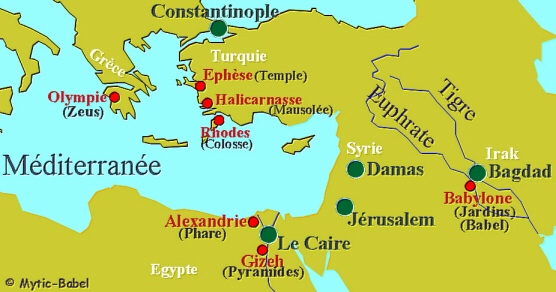
These monuments are located in Greece, northen Africa and minor Asia. Their date of construction varies from 2800 BC for the Pyramid of Giza to 280 BC for the Lighthouse of Alexandria.
Nowadays, the Pyramid of Giza is the only wonder who still exists. Excavations proved the existence of the other wonders, except of the Hanging Gardens of Babylon. Watch the video!


The New 7 Wonders of the World were announced during the Official Declaration ceremony in Lisbon, Portugal on Saturday, July 7, 2007 - 07.07.07:

• The Great Wall of China
• Petra, Jordan
• Christ the Redeemer, Brazil
• Machu Picchu, Peru
• The Pyramid at Chichén Itzá, Mexico
• The Roman Colosseum, Italy
• The Taj Mahal, India
-------
The nominees:
• The Acropolis of Athens, Greece
• Alhambra, Spain
• Angkor Wat, Cambodia
• The Pyramid at Chichén Itzá, Mexico
• Christ the Redeemer, Brazil
• The Roman Colosseum, Italy
• Statues of Easter Island, Chile
• The Eiffel Tower, France
• The Great Wall of China
• The Hagia Sophia, Turkey
• Kiyomizu Temple, Japan
• The Kremlin and Red Square, Russia
• Machu Picchu, Peru
• Neuschwanstein Castle, Germany
• Petra, Jordan
• The Pyramids of Giza, Egypt (Honorary candidate)
• The Statue of Liberty, United States
• Stonehenge, United Kingdom
• Sydney Opera House, Australia
• The Taj Mahal, India
• Timbuktu, Mali

You can check out this video to 'visualize'!


Παρασκευή 31 Μαΐου 2019

Perseus and Medusa

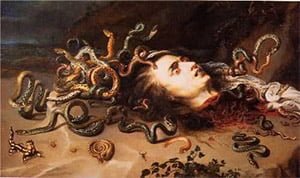
The myth of Perseus and Medusa

The myth of Perseus and Medusa is one of the best thriller-like tales in Greek Mythology.
With a promising plot that gets more complicated as the story progresses, this myth has a typical Hollywood-like scenario with the main character not being born yet at the moment when his destiny was determined.
Here, we will present just a short version of the myth of Perseus and Medusa – until the moment when Perseus beheaded Medusa.
perseus-medusa

Perseus and the Oracle

Acrisius, the king of Argos, was told by the oracle of Delphi that his own grandson would kill him one day. This grandson would be the child of his daughter Danae. Scared of the upcoming future and his destiny, King Acrisius decided to deprive his daughter of any possible intercourse, mating and child bearing, so he built a room beneath the earth and imprisoned Danae there.
However, as the legend says, Zeus came to her in the form of golden rain, pierced through the walls of chamber, and Danae’s body. Hence, Perseus was born. Hearing the news but not believing that Zeus was the father of the newborn, Acrisius let his daughter and grandchild out to the open sea on an ark. They eventually came to the shores of Serifos island, where they were saved and adopted by a local couple, the man being the brother of the king of the island, Polydectes.
When Perseus grew up to a handsome and strong young man, one more time he found himself in the way of one king, this time King Polydectes, who wanted Danae to become his wife. Knowing that he wouldn’t have the woman for himself as long as Perseus was there to protect her, the king made a plan to send Perseus not only far away but also to a dangerous mission. Polydectes told Perseus to bring him the head of the gorgon Medusa.

Perseus and Medusa

Medusa was one of three sisters, the gorgons, but she was the only mortal one. Some versions say all three were born as monsters, but the predominant myths had them as gorgeous maidens. Medusa was so beautiful that Poseidon was crazy about her, but she didn’t care about him; Poseidon turned her and her sisters into monsters with live snakes covering their heads. Medusa kept her beautiful face but everything else was so monstrous. And whoever dared to look into her face ended up being turned into stone.
Perseus thus had a hard task. He asked Athena and Hermes for help and two of them, together with the nymphs, provided winged sandals to fly him to the end of the world where gorgons lived, a cap that made him invisible, a sword and a mirrored shield. The latter was the most important tool Perseus had, since it allowed him to see a reflection of Medusa’s face and to avoid being turned into stone.
medusa-headWhen he cut Medusa’s head off, from the drops of her blood suddenly appeared two offspring: Pegasus, a winged horse, and Chrysaor, a giant or a winged boar. It’s believed that those two were Medusa’s children with Poseidon.
In any case, once he accomplished his task Perseus flew back and escaped Medusa’s sisters who tried to reach him. Later, Perseus used Medusa’s head as a weapon in many occasions until he gave the head to Athena to place it on her shield.
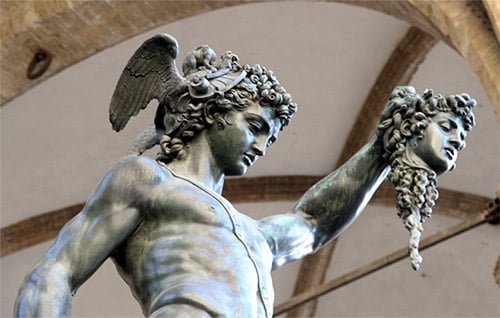
The myth of Perseus and Medusa was one the most powerful inspiration for many artists in the ancient times, but it hasn’t lost its artistic significance to the present day either. Paintings and sculptures of the moment of beheading or Medusa’s portrait itself are famous all over the world. One of the most known art work is the Medusa shield by Caravaggio, painted at the end of the 16th century. It is exposed in the Uffizi museum in Florence. Close by the museum, in the main plaza of Firenze (Florence) there is a sculpture of Perseus.

You can find an animated version of the myth here.


Πέμπτη 30 Μαΐου 2019

The Present Perfect Continuous(or Progressive)

The present perfect continuous expresses an action that recently stopped or is still going on. It puts emphasis on the duration or course of the action.


Form of Present Perfect Continuous

PositiveNegativeQuestion
I / you / we / they I have been speaking. I have not been speaking. Have I been speaking?
he / she / it He has been speaking. He has not been speaking. Has he been speaking?


Exceptions in Spelling

Exceptions in spelling when adding -ingExample
final e is dropped
(but: ee is not changed)
come – coming      
(but: agree – agreeing)
after a short, stressed vowel, the final consonant is doubled               sit – sitting
l as final consonant after a vowel is doubled (in British English) travel – travelling
final ie becomes y lie – lying


Use of Present Perfect Continuous

  • puts emphasis on the duration or course of an action (not the result)
    Example: She has been writing for two hours.
  • action that recently stopped or is still going on
    Example: I have been living here since 2001.
  • finished action that influenced the present
    Example: I have been working all afternoon.


    As with all continuous tenses remember: 

    Non-Continuous Verbs/ Mixed Verbs

    It is important to remember that Non-Continuous Verbs cannot be used in any continuous tenses. Also, certain non-continuous meanings for Mixed Verbs cannot be used in continuous tenses. Instead of using Present Perfect Continuous with these verbs, you must use Present Perfect.
    Examples:
    • Sam has been having his car for two years. Not Correct
    • Sam has had his car for two years. Correct


Key Words of Present Perfect Continuous

  • all day, for 4 years, since 1993, How long,.......?, the whole week
  •  
     
    Time for practice! 


School and creativity

Creativity expert Sir Ken Robinson challenges the way we're educating our children. He champions a radical rethink of our school systems, to cultivate creativity and acknowledge multiple types of intelligence.
 Let's hope that his ideas will someday be heard by the designers of the greek educational system. Especially the idea of 'human ecology' and how the 'system' only prepares students for a certain purpose.
Do not worry, the video presentation has got greek subtitles so everyone can watch.


Practice tense formation!


You can find a list of exercises to practice the formation of tenses here. You can choose level in each case.


Relative pronouns and adverbs (who, which...)

We use relative clauses to give additional information about something without starting another sentence. By combining sentences with a relative clause, your text becomes more fluent and you can avoid repeating certain words.

How to Form Relative Clauses 

Imagine, a girl is talking to Tom. You want to know who she is and ask a friend whether he knows her. You could say:
A girl is talking to Tom. Do you know the girl?
That sounds rather complicated, doesn't it? It would be easier with a relative clause: you put both pieces of information into one sentence. Start with the most important thing  – you want to know who the girl is.
Do you know the girl …
As your friend cannot know which girl you are talking about, you need to put in the additional information  – the girl is talking to Tom. Use „the girl“ only in the first part of the sentence, in the second part replace it with the relative pronoun (for people, use the relative pronoun „who“). So the final sentence is:
Do you know the girl who is talking to Tom?

Relative Pronouns 

Relative pronoun Use Example
whosubject or object pronoun for peopleI told you about the woman who lives next door.
whichsubject or object pronoun for animals and thingsDo you see the cat which is lying on the roof?
whichreferring to a whole sentenceHe couldn’t read which surprised me.
whosepossession for people animals and thingsDo you know the boy whose mother is a nurse?
whomobject pronoun for people, especially in non-defining relative clauses (in defining relative clauses we colloquially prefer who)I was invited by the professor whom I met at the conference.
thatsubject or object pronoun for people, animals and things in defining relative clauses (who or which are also possible)I don’t like the table that stands in the kitchen.


 Subject Pronoun or Object Pronoun? 

Subject and object pronouns cannot be distinguished by their forms - who, which, that are used for subject and object pronouns. You can, however, distinguish them as follows:
If the relative pronoun is followed by a verb, the relative pronoun is a subject pronoun. Subject pronouns must always be used.
the apple which is lying on the table
If the relative pronoun is not followed by a verb (but by a noun or pronoun), the relative pronoun is an object pronoun. Object pronouns can be dropped in defining relative clauses, which are then called Contact Clauses.
the apple (which) George lay on the table


 Relative Adverbs 

A relative adverb can be used instead of a relative pronoun plus preposition. This often makes the sentence easier to understand.
This is the shop in which I bought my bike.
→ This is the shop where I bought my bike.
Relative adverb Meaning Use Example
whenin/on whichrefers to a time expressionthe day when we met him
wherein/at whichrefers to a placethe place where we met him
whyfor whichrefers to a reasonthe reason why we met him


 Defining Relative Clauses 

Defining relative clauses (also called identifying relative clauses or restrictive relative clauses) give detailed information defining a general term or expression. Defining relative clauses are not put in commas.
Imagine, Tom is in a room with five girls. One girl is talking to Tom and you ask somebody whether he knows this girl. Here the relative clause defines which of the five girls you mean.
Do you know the girl who is talking to Tom?
Defining relative clauses are often used in definitions.
A seaman is someone who works on a ship.
Object pronouns in defining relative clauses can be dropped. (Sentences with a relative clause without the relative pronoun are called Contact Clauses.)
The boy (who/whom) we met yesterday is very nice.


Non-Defining Relative Clauses

Non-defining relative clauses (also called non-identifying relative clauses or non-restrictive relative clauses) give additional information on something, but do not define it. Non-defining relative clauses are put in commas.
Imagine, Tom is in a room with only one girl. The two are talking to each other and you ask somebody whether he knows this girl. Here the relative clause is non-defining because in this situation it is obvious which girl you mean.
Do you know the girl, who is talking to Tom?
Note: In non-defining relative clauses, who/which may not be replaced with that.
Object pronouns in non-defining relative clauses must be used.
Jim, who/whom we met yesterday, is very nice.


How to Shorten Relative Clauses? 

Relative clauses with who, which, that as subject pronoun can be replaced with a participle. This makes the sentence shorter and easier to understand.
I told you about the woman who lives next door. – I told you about the woman living next door.
Do you see the cat which is lying on the roof? – Do you see the cat lying on the roof?


You can do online exercises by clicking on the links above:


Source: http://www.ego4u.com


The Present Perfect Simple

FORM

[has/have + past participle]
Examples:
  • You have seen that movie many times.
  • Have you seen that movie many times?
  • You have not seen that movie many times.
Complete List of Present Perfect Forms

USE 1 Unspecified Time Before Now


We use the Present Perfect to say that an action happened at an unspecified time before now. The exact time is not important. You CANNOT use the Present Perfect with specific time expressions such as: yesterday, one year ago, last week, when I was a child, when I lived in Japan, at that moment, that day, one day, etc. We CAN use the Present Perfect with unspecific expressions such as: ever, never, once, many times, several times, before, so far, already, yet, etc.
Examples:
  • I have seen that movie twenty times.
  • I think I have met him once before.
  • There have been many earthquakes in California.
  • People have traveled to the Moon.
  • People have not traveled to Mars.
  • Have you read the book yet?
  • Nobody has ever climbed that mountain.
  • A: Has there ever been a war in the United States?
    B: Yes, there has been a war in the United States.

How Do You Actually Use the Present Perfect?

The concept of "unspecified time" can be very confusing to English learners. It is best to associate Present Perfect with the following topics:

TOPIC 1 Experience (=Eμπειρίες)

You can use the Present Perfect to describe your experience. It is like saying, "I have the experience of..." You can also use this tense to say that you have never had a certain experience. The Present Perfect is NOT used to describe a specific event.
Examples:
  • I have been to France.
    This sentence means that you have had the experience of being in France. Maybe you have been there once, or several times.
  • I have been to France three times.
    You can add the number of times at the end of the sentence.
  • I have never been to France.
    This sentence means that you have not had the experience of going to France.
  • I think I have seen that movie before.
  • He has never traveled by train.
  • Joan has studied two foreign languages.
  • A: Have you ever met him?
    B: No, I have not met him.

TOPIC 2 Change Over Time(=Αλλαγές μέσα στο χρόνο)

We often use the Present Perfect to talk about change that has happened over a period of time.
Examples:
  • You have grown since the last time I saw you.
  • The government has become more interested in arts education.
  • Japanese has become one of the most popular courses at the university since the Asian studies program was established.
  • My English has really improved since I moved to Australia.

TOPIC 3 Accomplishments(=Επιτεύγματα)

We often use the Present Perfect to list the accomplishments of individuals and humanity. You cannot mention a specific time.
Examples:
  • Man has walked on the Moon.
  • Our son has learned how to read.
  • Doctors have cured many deadly diseases.
  • Scientists have split the atom.

TOPIC 4 An Uncompleted Action You Are Expecting(=Αναμενόμενες πράξεις που δεν έχουν τελειώσει)

We often use the Present Perfect to say that an action which we expected has not happened. Using the Present Perfect suggests that we are still waiting for the action to happen.
Examples:
  • James has not finished his homework yet.
  • Susan hasn't mastered Japanese, but she can communicate.
  • Bill has still not arrived.
  • The rain hasn't stopped.

TOPIC 5 Multiple Actions at Different Times(=Επαναλαμβανόμενες πράξεις στο παρελθόν σε διαφορετικές στιγμές)

We also use the Present Perfect to talk about several different actions which have occurred in the past at different times. Present Perfect suggests the process is not complete and more actions are possible.
Examples:
  • The army has attacked that city five times.
  • I have had four quizzes and five tests so far this semester.
  • We have had many major problems while working on this project.
  • She has talked to several specialists about her problem, but nobody knows why she is sick.

Time Expressions with Present Perfect

When we use the Present Perfect it means that something has happened at some point in our lives before now. Remember, the exact time the action happened is not important.

Sometimes, we want to limit the time we are looking in for an experience. We can do this with expressions such as: in the last week, in the last year, this week, this month, so far, up to now, etc.

Examples:
  • Have you been to Mexico in the last year?
  • I have seen that movie six times in the last month.
  • They have had three tests in the last week.
  • She graduated from university less than three years ago. She has worked for three different companies so far.
  • My car has broken down three times this week
  •  
Key words: lately, recently, already, yet, ever, never, so far, since+point in time, for+period of time e.t.c.

Now try to do these exercises to practice on this tense!

Exersice 1
Exercise 2


(Source: http://www.englishpage.com)

Conditionals

1. The Zero Conditional (Type 0)

The zero conditional is a structure used for talking about general truths, or scientific facts -- things which always happen under certain conditions.

A zero conditional sentence consists of two clauses, an "if" clause and a main clause (note that most zero conditional sentences will mean the same thing if "when" is used instead of "if"). For example:
If the "if" clause comes first, a comma is usually used. If the "if" clause comes second, there is no need for a comma.
The simple present tense is the tense use in both clauses. Examples:
If you cross an international date line, the time changes.
Phosphorus burns if you expose it to air.

2. First Conditional (Type I)

The first conditional (also called conditional type 1) is a structure used for talking about possibilities in the present or in the future.Type 1: if + present + future.
Example:
If I have the money, I will buy this car.
If it's sunny, we'll go to the park.
Peter will be sad if Susan leaves.
If you cook dinner, I'll wash the dishes.
Among other variations the structure if + present + present is also possible. It is used when the results are habitual or automatic. Example: If a commodity is in short, supply prices tend to rise.

3. Second Conditional (Type II)

The second conditional (also called conditional type 2) is a structure used for talking about unreal situations in the present or in the future.Type 2: if + past + conditional
Example:
If I had the money, I would buy this car. (Since I do not have the money I cannot buy any new car). The action in type 2 is characterized by unreality.
If I were you, I would drive more carefully in the rain.
If dogs had wings, they would be able to fly.
Paula would be sad if Jan left.

4. Third Conditional (Type III)

The third conditional (also called conditional type 3) is a structure used for talking about unreal situations in the past. In other words, it is used to talk about things which DID NOT HAPPEN in the past. Type 3: if + past perfect + perfect conditional
Full form : If I had studied harder, I probably would have passed the exam.
Contracted form :If I'd studied harder, I probably would've passed the exam.
Example:
If I had had the money, I would have bought this Audi. (But I did not have it, and so did not buy).
If you had driven more carefully, you would not have had an accident. (You had an accident because you didn't drive carefully enough.)
If we had played a little better, we could have won the game.(We didn't play well, so we lost the game.)
The action in type 3 is characterized by impossibility.

While type 1 and type 2 focus on the present or future, the time in type 3 is the past and signifies a completed action in the past. The condition, therefore, cannot be fulfilled because the action in the if-clause did not happen.

Practice time!


Sources:


Learning English? Check this out!

Learning English can be an interesting and enjoyable process for all those involved.... teachers, learners and speakers. Watch these videos to understand what I mean...

                                          A scene from the greek movie 'Καλώς ήρθε το δολλάριο'

Correct pronunciation is indeed important so do not get angry the next time your teacher insists on a new word. Check out why!


             Practice makes perfect????


'We are sinking, we are sinking...' What a difference does a letter make!


Wanna be a translator???? Well, body language is not enough...


However, as the following video shows everybody can learn provided that he/she has got strong will (oh, yes, and if he/she does his/her English homework regularly!).

                                                  Zoumpoulia from 'Παρά πέντε' in action


Τετάρτη 8 Μαΐου 2019

The myth of king Midas

Myth of King Midas and the Gold

King Midas is one of the most known and controversial personas in the Greek Mythology. King of Phrygia, Midas, was known for his wisdom but also his greed. Although one of the most known kings of his time, a fanatic lover of the Arts and Culture, creator of a gorgeous rose garden, Midas was known to be extremely greedy, trying to accumulate the largest amount of money and wealth in the known world.

Myth of Midas’ Gold

According to the Greek myth, God Dionysus found himself in Phrygia once, followed by a group of Satyrs and other creatures that were always celebrating and feasting with him. Silenus, one of the Satyrs, entered the sacred Rose garden of Midas and the guards brought the intruder to the King.
Midas recognized the follower of Dionysus and decided not to punish him, especially since Silenus decided to stay at the court entertaining Midas with frantic stories about the pleasures of life. God Dionysus was pleased with Midas and his decision not to punish Silenus, thus asked Midas what he wanted the most from his life – in order to return the favor.
Midas said that he wished everything he touched could turn to gold. Although Dionysus warned Midas about the potential dangers of such a wish, Midas insisted on it and Dionysus granted him with the infamous Midas Touch.

The curse of Midas’ touch

midas touch turned everything to gold

Midas was thrilled with the gift because he could turn everything to gold, soon though, he realized that he was unable to eat, drink or do anything normally, since everything he touched would turn to Gold. Midas started understanding the warnings of Dionysus and the depth of his mistake and greed.
Midas went to Dionysus, desperate, and begged him to free him from this “curse”. Dionysus told Midas that he had to go and bathe in the River Paktolos (Pactolus) in order to wash away this ability.
Midas indeed went to Paktolos river and washed himself; according to the myth the gold settled in the sand of the river and was carried to another country of the East, Lydia, that became one of the richest countries of the antiquity.

Meaning of Midas’ myth

This myth gives an explanation why River Pactolus is rich with gold, but mostly refers to one of the most known beliefs of the Greeks, the short-sighted wish, and the punishment for greed.
The phrase Midas Touch is used till today to describe the ability of a person to make lots of money or create successful events, build a career and wealth. It has lost its negative meaning, although it is still associated with greed.
Midas is used as a personification of greed, which is considered one of the seven deadly sins.

Source: http://www.greekmyths-greekmythology.com


Πέμπτη 18 Απριλίου 2019

Easter in Britain

Let's have a look on how Easter is celebrated in Britain. Can you find any similarities / differences with the Greek Easter celebrations???

easter 2


In the UK Easter is one of the major Christian festivals of the year. Easter eggs, Easter bunny and sending Easter cards are traditions not only in Britain.
It is preceded by forty days of Lent. Shrove Tuesday, also called Pancake Day, is the last day before the period of fasting which starts on Ash Wednesday.
The Sunday before Easter is called Palm Sunday. This is the begining of Holy Week.
Maundy Thursday is the Thursday before Easter. In Britain, the Queen takes part in the Ceremony of the Royal Maundy. This involves the distribution of Maundy Money to deserving senior citizens (one man and one woman for each year of the sovereign's age), usually chosen for having done service to their community. They receive ceremonial red and white purses which contain coins made especially for the occasion. The white purse contains one coin for each year of the monarch's reign. The red purse contains money in place of other gifts that used to be given to the poor


maundy coins

Maundy Thursday is followed by Good Friday. It is celebrated as a bank holiday, when people do not go to work. Britons eat the so called hot cross buns containing currants and marked with a cross.
An old rhyme was often sung by children awaiting their sugary treat:

"Hot cross buns,
hot cross buns,
one a penny, two a penny,
hot cross buns.
If you do not like them,
give them to your sons,
one a penny, two a penny,
hot cross buns."

hot cross buns

On Easter Sunday, which is the Christian feast of the Resurrection of Jesus, people eat Easter eggs. Many families gather together at dinner and organize egg hunts. Children have a lot of fun looking for dyed eggs hidden in the house and in the garden.  

easter hunt


A traditional way of breaking the Lenten fast is to eat some simnel cake. These are raised cakes, with a crust made of fine flour and water, coloured yellow with saffron, and filled with a very rich plum-cake, with plenty of candied lemon peel, and dried fruits.


simnel cake


The day after Easter Sunday is known as Easter Monday. It is also a bank holiday in the UK. In some areas "egg rolling" is still popular today. People take the eggs to the top of a hill and roll them down. The first egg to get to the foot of that hill is the winner.


Παρασκευή 29 Μαρτίου 2019

WELCOME!

Hello and welcome to my blog……
This blog is an attempt to supplement my teaching and perhaps motivate students. Teachers are also welcome of course!

Talk to you soon.

etwinning

https://padlet.com/ancastan1004/student-and-parental-opinions-about-the-project-c16g929li9hoh18o https://docs.google.com/forms/d/e/1FAIpQLSc...